Monday, November 9, 2015

Honor our Veterans November 11th and on all days

Find yourself or other Veteran family members or friends by clicking on the image below and conducting a search. Be it you are kinfolk or not, I would be pleased to know the names you discover & the stories you share. Email to: john.t.richards@sbcglobal.net
If you need assistance, just ask & I will do my best to help. 
 https://blogger.googleusercontent.com/img/b/R29vZ2xl/AVvXsEgy3dqar-KWX7eGXJF6W-uV9vCsODDiZ9zNLsfemeIw9ZDSiv2wU-k00L7NJpPy5Yi_NMh1mVVKXR2rg4jnxEBw9p-2JFzuGUqHSam8HeMtSEzhFxvpuUbYG513RM8qjpzDHjCdr886p3w/s1600/honorwall+pic.jpg
From Fold3.com

History of Veterans Day
 
Still a lot of work to do on these but it's a start.

Carroll 'Cal" Steunenberg 

Frank 'Bud' Steunenberg 

Jule 'Juke' Steunenberg
(above are the three sons of Julian & Francis Steunenberg & my uncles)

Robert K. Steunenberg

Bernardus Steunenberg


George Steunenberg


Robert 'Bob" J. Richards (my father John Sr.'s brother and my uncle) 

Nile C. Kinnick (not family but did find a connection) 

Ronald L. Longanecker (my wife Cindy's cousin)


Jim Carl Behlen Jr., U.S. Navy (my wife Cindy's brother)

Frederick J. Mandella (Cindy's paternal grandfather)

Walter 'Gary' Osborne (my brother) 


Bob Allen (brother in-law, Navy, need more info on Bob)

Timothy Underwood (my nephew)

Justus L. Simpson (Way back on Grandma Francis S. side) 

Lewis Simpson (brother of Justus)

Sergeant Stubby (kind of reminds me of my old mutt from childhood) 

Saturday, November 7, 2015

"Boise, Idaho, 1901, Legislature" & a bit of Idaho Suffrage too

Here is a nice original photo I acquired of the 1901 Sixth Idaho legislature taken on the steps of the Territorial Capital building. As we know, Frank served here as governor from 1897-1901 when some of these legislator's were no doubt also members of the Fourth and Fifth legislatures during his administration.

"The sixth session of the State Legislature began at Boise on Monday, January 7, 1901, and adjourned sine die on Tuesday, March 12, 1901. During the session Lieut.-Gov. Thomas F. Terrill served as president of the Senate, and Glen P. McKinley, of Shoshone County, as speaker of the House. Governor Hunt's administration commenced with the opening of the session.  In his message he gave a comprehensive account of the Coeur d'Alene riots and announced that the cost to the state of restoring order in the troubled district was $59,849.66. He also stated that martial law was still in force and that United States troops still occupied Shoshone County." — History of Idaho Gem of the Mountains

Only one person, William Edward Adams, is identified on the back of the photograph. I will start searching my books and photos to see who else I can ID but no doubt need a lot of help with this one. Please let me know if you can identify any of these gents and ladies.
I will assume the "ribboned hat" is the one on the lady to the right (looks like a forest up there!) and William Edward Adams is the gentleman directly behind unless they are referencing the fella just to the right. However, I could be wrong and a bit of enlightenment on the subject of hats might be necessary. Who are these ladies? Wives, legislative aids, elected members, Idaho suffragettes?

Below from History of Idaho: The Gem of the Mountains, Volume 4. I have volumes 1, 2, & 3 but not the hard to find 4 yet. Looking for one if you have it.
William was born 8/3/1861, died 6/3/1937 & is buried at Hillcrest Cemetery, Weiser, Washington Co., Idaho (Find A Grave).

For more on Governor Steunenberg and the fourth and fifth sessions of the State Legislature, and the above Sixth session, click on the link below.
History of Idaho
James H. Hawley, Editor
From Steunenberg to Morrison

"By a vote as flattering as it was just, the electors of the state, at the last election, conferred the privilege of the ballot upon women. I take this opportunity of welcoming them to the ranks of voters and feel sure that, in their new capacity, they will exert the same influence for good that has characterized the sex since creation's dawn. I recommend such legislation as may be necessary to carry out the full purpose and extent of this amendment." 
—Governor Frank Steunenberg, January, 1897

Other Related:
Sunday, January 6, 2008
Woman Suffrage in Idaho by Governor Frank Steunenberg

The Woman's Column

Saturday, October 17, 2015

2007 Blog Flashback - Governor Steunenberg Commemorative Medal & other items circa 1900

As I wind down on the 8th year of this blog, I am going to start going back to the beginning and do an occasional flashback of interesting items that may have become buried and forgotten.

I haven't discovered and recovered any significant family specific items such as these since 2007. A significant and very pleasant surprise at the time. Let's take a look back.

Saturday, December 29, 2007 

Never Know What Might Pop Up On eBay

All of the items mentioned below on my blog were purchased by me as a lot on eBay.

Commemorative medal given to my great grandfather in 1900 

I find a lot of items related to our family and Idaho history but to find these personal mementos that at one time belonged to my great grandfather, great grandmother and their children was quite a surprise. Typically items such as this would have been retained and preserved. I suspect these got separated somewhere in the course of death, divorce, relocation, estate sales and perhaps even theft. I am always saddened when I see things of a very personal family nature going to the highest bidder and was afraid the same was going to happen here. Love it or hate it, eBay is now the world's garage and estate sale and anything is possible. I had to pay a price but was delighted that I was the high bidder on this one and these items were able to find there way back to the family.

As a side note, many of the documents related to the Steunenberg administration and Coeur d’Alene mining issues are at the College of Idaho archives.


Other sites of interest include:

If you haven't been to the site yet, your will want to check out Assassination: Idaho's Trial of the Century. (Many more links of interest are listed here under "resources"). I recommend supporting public television by purchasing the DVD of the program. It was a lot of fun to contribute and I even got a few seconds of on screen fame!  

Idaho Legal History Society (some repeats from my blog). The logo you see is of Governor Steunenberg. 

Bill Haywood Trial

Idaho State Historical Society

Idaho Capitol Building

Nothing unusual but a small, looks like dated "67" although car is earlier, photo of the Idaho Capitol Building taken from behind Frank's Statue. Posting on here before it disappears into a photo box.

 
A earlier photo (circa 1950's) of the Steunenberg boys in front of their father's status. My grandfather Julian on the left and Frank Jr. on the right. Julian was about 18 and Frank about 5 at the time of their fathers assassination.

Sunday, October 4, 2015

"Cal Poly crushes Idaho State" (from Idaho Statesman)

Saturday, October 3rd, 2015

Just a reminder if you missed it last night. 

Cal Poly San Luis Obispo 58 - Idaho State 26

OK, so I am piling it on some of my Idaho family/friends! Been on the other side of the fence too.

Cal Poly routs Idaho State

More Football:

Sunday, September 28, 2014
Bob & John Richards (AKA Ricciotti), Football & Nile Kinnick

Sunday, October 19, 2014
Addendum to Sunday, 9/28/2014 post about Bob Richards (AKA Ricciotti), Roman Catholic High School, Univ. of Iowa Hawkeye Football & Nile Kinnick

Saturday, April 25, 2015
Nile Kinnick isn't the only one from Iowa

Monday, December 8, 2014
We will "Remember the Titans"!

Saturday, January 16, 2010
College of Idaho Football Team circa 1908
 

Sunday, September 20, 2015

Idanha Hotel Match Safe

Here is an item currently listed on eBay related to the Idanha Hotel. A early 1900's match safe, match box or sometimes called a Vesta case. Since I didn't have a spare $1,200 in my collectibles cookie jar at the moment, I settled for asking the seller, stroyer500, for permission to use a couple photographs. Permission was granted and in return I get to share this very interesting item and am happy to also provide a bit of free advertising.


In all my Idaho searching I have never seen another one of these. Have any of my fellow Idaho collectors seen one? How rare are they? If you have one, or know more about these, please let me know at: john.t.richards@sbcglobal.net

This is really a nice Idanha collectible!
Other Related:  

Idanha search of this blog

Cooper Hewitt Matchsafe collection

Saturday, September 19, 2015

More Main Street, Caldwell, Idaho

Here is a recent real photo post card I acquired with a view down Main Street, Caldwell, Idaho. I would say circa 1905-08. The photo was incorrectly described by the seller as Nampa, ID. That didn't fool a handful of us Caldwell collectors who pursued it in a spirited manner!  I am going to put a few pics up here without too much commentary. You can find quite a bit on this blog about 7th and Main or just click here for a sample search.
Looking down Main Street toward the intersection with 7th Street. 

Interurban coming up Main Street
Looks like an early car parked on the street. Maybe Walter Sebree's down near where I believe the First National Bank was located and he was President? Here is an excerpt from an article appearing 1/18/15 in the Idaho Statesman written by historian Arthur Hart. Click here for the full article. 
It was the wealthier and more adventuresome citizens who bought the first cars, and the Idaho Statesman reported regularly on their exploits. On Jan. 2, 1904, under the headline "SWELL AUTO" came this: "Walter Sebree came over from Caldwell yesterday in his new automobile, covering the distance in about two hours. The car is a handsome vehicle of considerable size and good lines. It attracted much attention as it stood on Eighth Street." Fast runs between towns were reported regularly that year, as when E.H. Dewey and L.C. Van Riper came over to Boise from Nampa in an hour and 10 minutes. (These "fast runs" averaged about 12.5 miles per hour.)

Read more here: http://www.idahostatesman.com/2015/01/18/3597595/the-first-decade-of-the-auto-in.html#storylink=cpy
Saratoga Hotel on the right with the Caldwell Bank & Trust/Steunenberg Block on the opposite corner across 7th Street.

Saturday, September 5, 2015

Utah event honors Joe Hill, hero to many, murderer to others


Click here: Utah event honors Joe Hill, hero to many, murderer to others

(Utah state archives/The Salt Lake Tribune via AP). This photo from the Utah state archives shows Joe Hill’s prison records, identifying him as Joseph Hillstrom. Lionized in a song sung by Pete Seeger and Bruce Springsteen, labor activist and songwriter.


Freedom's road seems rough and hard,
And strewn with rocks and thorns,
Then put your wooden shoes on, pard,
And you won't hurt your corns.
To organize and teach, no doubt,
Is very good, that's true,
But still we can't succeed without
The Good Old Wooden Shoe.
--Joe Hill

Sunday, August 30, 2015

Bunker Hill & Sullivan Concentrator...before and after the wreck.

I wanted to share this great photograph I recently acquired. It's an image we have seen before, online and in the "after the wreck" postcard shown further down on this post. However, this one is an original T. N. Barnard Studios photo with period cardboard backing and nicely labeled. I recently purchased it from a seller up in Coeur d'Alene, Idaho (seems only appropriate it come from there). The photograph shows the aftermath of the bombing of the Bunker Hill and Sullivan (BH&S) concentrator on April 29, 1899 and would set events in motion eventually leading to the bombing and assassination of Governor Steunenberg on December 30, 1905.
John T, Richards Collection
Here's an excerpt from Big Trouble by J. Anthony Lukas that deals with the blowing up of the BH&S. I had previously typed a portion from the book, have added more here and will probably still add a couple paragraphs I skipped. Too much typing so there may be a typo here and there but I caught most of them. Probably add some additional related links too. If you have anything to add regarding this event, let me know and I will usually be happy to do so or you can leave comments by clicking on the comments link at the bottom of the post.

     "As the nineteenth century drew to a close, Bunker Hill was a thriving enterprise.  In 1893, when Bradley assumed its management, the corporation had been deeply in debt and had never paid a dividend.  In the years since, it had moved into the black, paying over $600,000 in dividends. By April 1899, the miners union concluded that the time had come to confront Bunker Hill head-on, in hopes of compelling union recognition and union wages.  Early that month, Ed Boyce, president of the Western Federation of Miners, then based in Butte, met with leaders of the Wardner union. On April 18, notices sprouted in the mining camp warning anyone not yet a union member to join immediately. On April 23, a workers' delegation called on Bunker Hill's acting manager, Frederick Burbidge, to present its demands. Burbidge put into effect a plan aimed at driving a wedge between the union members (roughly 100 men) and the rest of the company's workforce (about 350). He promptly granted a wage increase—to the "old scale" of $3.50 a day for miners, $3.00 for muckers—thus, it was hoped, satisfying the nonunion faction.  But he refused the request for union recognition.  Albert Burch, the superintendent, said the company would "shut down and remain closed for twenty years" before it would recognize the union.  Union men should report to the office, where they'd be paid and dismissed. On his own initiative that day, Burch fired seventeen men he believed to be union members.
Before the wreck
      Three days later, some 150 unionists, many of them armed, turned workers away from the mine with dire threats, while another group seized the tramway carrying ore from mine to mill, effectively halting Bunker Hill's operations.  Fearing for his life—with some justification—Fred Burbidge fled to Fairfield, Washington, where he wired Steunenberg in Boise, reporting the situation and adding.  "County authorities unable to cope with mob, and we appeal to you for protection for ourselves and our men."  Steunenberg promised to investigate but reminded Burbidge of the new state law providing for arbitration of labor disputes.  "Nothing to arbitrate," Burbidge fired back.  "I again renew my request for protection."  Steunenberg telegraphed James D. Young, the county's Populist sheriff, asking for a report, to which Young replied:  "Am on the ground. All is quiet. No armed mob.  Matters are orderly."
     Early on April 9, Burbidge heard from undercover detectives that more efforts would be made to intimidate his nonunion workers.  He promptly alerted Steunenberg, who warned Young to stay on top of the situation. The threat that bright spring morning came not from Wardner's embattled union but from the entrenched unionists along Canyon Creek.  Up the narrow canyon in the cramped mining camp of Burke, the Northern Pacific's"down train" was about to make its seven-mile morning run to Wallace, when the engineer, Levi W. Hutton, and the conductor, George Olmstead, noted 250 miners in their "digging clothes," some wearing masks and others armed with rifles, climbing aboard the two passenger cars and eight boxcars.  Hutton and Olmstead later claimed innocence in the matter, though authorities accused them of "moral cowardice and truculent subserviency."  According to Hutton, two masked men with Winchesters jumped into his cab and told him, "Pull out for Wallace, and be damned quick about it!"  A mile down the track, in the mining camp of Mace, a hundred more miners got on.  The masked men ordered another stop at the powder house of the Helena-Frisco mine, where workers loaded eighty wooden boxes, each containing fifty pounds of dynamite.  At Gem, another 150 to 200 miners armed with rifles joined their colleagues on the train, along with three freight cars to accommodate the newcomers.
    When the train completed its scheduled run at Wallace, the station platform seethed with 200 more miners, who'd walked seven miles from Mullan, retrieving weapons cached in a manure pile along the way.  The authorities later pointed to this as proof of how carefully the operation had been planned, allegedly at mining camp meetings the night before (the men of Mullan--representing the largest local union in the state-defiantly refused to wear disguises). Now the masked men in the cab ordered Hutton to head for Wardner, twelve miles west.  "We can't go to Wardner," he said he told his captors, explaining that the Northern Pacific track didn't go there and they'd have to ask permission to run on the "foreign track" of the Oregon Railway and Navigation Company.  Even with running orders it wasn't safe:  "This engine weighs about 115 tons and we'll go through the bridges.  Besides, there are trains on the O.R. & N. and we're liable to have a collision and kill fifty men."
     A railway agent named Lambert refused permission to run on his tracks, but the masked men were adamant. So the rogue train pushed through the transfer switch, ringing its bell and sounding its whistle, which Hutton had rigged with a chime made by a Wallace plumber, giving it a distinctive tone. As an additional precaution, Hutton ordered the brakeman, Thomas Chester, to act as flagman, waving his red banner to warn any oncoming train of their unscheduled run.  Since there were many curves on this stretch--requiring the flagman to intercept any train that might be out of sight round the turn—the train crawled along, reaching Kellogg just before noon.
     A mile from its destination, several hundred men from the Bunker Hill and Last Chance mines managed to squeeze aboard. As the train pulled into the Kellogg depot, which served as the railhead for Wardner's mines and mills, nearly a thousand men were jammed onto the nine freight and ore cars, one passenger coach, and two engines (one front and one rear).  Some two hundred had covered their faces with masks made from pillowcases, buckskin, or American flags; these same men were armed with Winchesters, shotguns, and baseball bats. The 'train was 'literally black with men' recalled a Spkane newsman. 'The engine itself was covered all over with armed men and everywhere a man could gain a place to sit or stand or hold on to, he was there.' Each miner on the train wore a strip of white muslin buttonhole or a white cloth tied around his right arm.
After the wreck
     In midmorning, Fred Burbidge had telephoned the mine superintendent at the concentrator to warn the non union men to 'make for their own safety.' When the attackers realized the concentrator was unmanned, they sent word to the main party still gathered by the train, to bring forward its lethal cargo. Even then, it isn't clear whether  these seven to eight hundred men knew what was about to happen. In 1892, a smaller group of unionists had come to Wardner, persuaded Bunker Hill  executives that dynamite was in place t\beneath the mine's concentrators, then used that leverage to get rid of the scabs. Many who boarded the train seven years later may have expected a repeat of the famous bluff.
     Others had a bolder scheme in mind, placing sixty boxes of dynamite at three locations below the concentrator. At 2:35, they lit the fuses. In a few seconds three consecutive blasts reduced the concentrator to splintered wood and billows of dust. The Bunker Hill office containing all the records, the company boardinghouse, and several smaller buildings were also destroyed by the explosion or fire. By 2:50, the raiding party and most of the others who'd arrived in Kellogg at noon were back on the train—now dubbed the Dynamite Express—which hastily retreated. From Kellogg to Wallace, ranchers and laboring people lined the tracks and, according to one eyewitness, "cheered the [union] men lustily as they passed." 
 —Big Trouble: A Murder in a Small Western Town Sets Off a Struggle for the Soul of America
by J. Anthony Lukas.
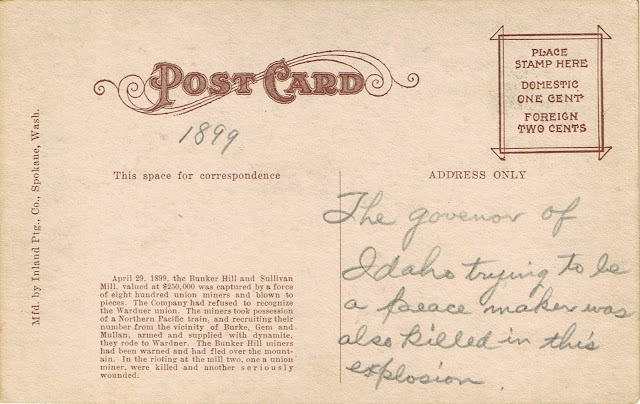
"The governor of Idaho trying to be a peace maker was also killed in this explosion." Someone had either heard a bad rumor or had their history wrong as we know the governor, Frank Steunenberg, was not killed in this explosion. 
As you have seen many times before, Frank was killed in this explosion when he entered the side gate of his home on 16th Avenue in Caldwell, Idaho on 12/30/1905 

All the images above are from originals owned by me. Unauthorized use is prohibited. In other words, have the decency to contact me, ask first and cite the source appropriately.

Other Related:

Saturday, July 4, 2015

Fourth of July in Farmington. So who's the boy?

Happy 4th of July. Hope you are enjoying a good one. Here is a partial re-post from a few years back.

If you have been paying attention, you should know the "boy" in the excerpt below. This is an easy one. How many more hints do you need!

"The Fourth of July in Farmington began with a fanfare from the town's brass band, resplendent in gold and white, rumbling down Main Street in a wagon pulled by a four-horse team. Later, in a shady grove by the river, there'd be fried chicken, iced lemonade, a baseball match, fireworks at a recitation of the Declaration of Independence—and always a lawyer over from the county seat to deliver the patriotic oration.

The boy would see the lawyer's horse and buggy at the hotel in the morning, and think 'how nice they were, and how much money a lawyer must make.' When the visitor got up to speak, the boy noticed his 'nice clothes—a good deal nicer than those of farmers and other people who came to hear him talk—and his boots looked shiny, as if they had just been greased.' He talked very loud, 'and seemed to be mad about something, especially when he spoke of the war and the Bridish (sic), and he waved his hands and arms a great deal.' On he went in the midday sun, about the flag, and the G.A.R., and because our people were such great fighters,' and how they must be 'ready to fight and to die' for that flag. The farmers clapped their hands and said the lawyer was 'a mighty smart man' and 'could talk louder than anyone we had ever heard.' The boy thought 'what a great man he was, and how [he himself] should like to be a lawyer.'"

So click comment at the bottom of this post and tell me who is the boy! Was he born in Farmington? 

Related: Sunday, July 4, 2010
The Unanimous Declaration of the Thirteen United States of America

Wednesday, July 1, 2015

7/1/15 - The People's Daily - Morning Star

JTR Collection
I will continue to post articles from time to time that are related to the topics on this blog―all viewpoints are welcomed. Click on the link below to read this one.

One Big Union, Three Giant Labour Heroes


Two of the three mentioned in the article are pictured to the left: Gurley Flynn and Bill Haywood.

And of course Joe Hill. On my bookshelf. A good read.
JTR Collection

More....

Saturday, May 21, 2011  

More Reader Comments, Joe Hill, Unions, Violence/Non-Violence, Harry Orchard, etc.

Sunday, June 28, 2015

Idaho Statesman Editorial 6/26/2015

Governor Butch Otter

Statesman: Same-sex ruling puts to rest decades of debate

From the Idaho Statesman Editorial Board (click above for full editorial): "We feel it is time for those in this state who object to the ruling to live and let live, and for those who can see their way clear to love and let love. Idaho same-sex couples who are already married, and those who will be, are entitled to every legal benefit and every “for better, for worse, for richer and poorer” attraction the institution affords." (Statesman editorials are the unsigned opinion expressing the consensus of the Statesman’s editorial board. To comment on an editorial or suggest a topic, email editorial@idahostatesman.com.) 

I see this photo floating around that has given Governor Otter a bit of color. Although it was a far different time in our history, I like to think Governor Steunenberg would have been on the right side of this issue as he was in regards to Women Suffrage in Idaho in the late 1800's/early 1900's, which also elicited very strong points of view―with suffragettes ridiculed, spat upon and even jailed because of their advocacy for voting rights. Although Governor Otter may not welcome the rainbow in regards to marriage equality, I would hope that if my great grandfather were governor today that he would view it favorably―despite the likely objections from many others in Idaho as were also voiced in regards to voting rights for women in his day. 

Gov. Steunenberg in rainbow color.

JTR Collection


Also in the Spokesman Review 6/3/1900: Woman Suffrage In Idaho
Read more here: http://www.idahostatesman.com/2015/06/26/3871411/statesman-editorial-same-sex-ruling.html#storylink=cpy

Read more h ere: http://www.idahostatesman.com
/2015/06/26/3871411/statesman-editorial-same-sex-ruling.html#storylink=cpy

Wednesday, June 24, 2015

From Centennial Citizen: "Mad bomber of Cripple Creek"

Article in the 6/23/2015 Centennial Citizen by Rob Carrigan.  Click on the link below. 


Harry Orchard claimed he was made a tool of the union

Monday, June 22, 2015

Who is Rose Flora? What could she tell us? What do you know about her? Are there any photos of Rose?

On the morning of December 30th, 1905:
"Their hired girl, Rose Flora, served up the austere breakfast prescribed by Adventists: wheat cereal, stewed fruit, perhaps an unbuttered slice of oatmeal bread (the sect believed that butter-like eggs, bacon, other meats, coffee, and teas—stimulated the 'animal passions')."

OK, so maybe not as as drama packed as the missing Jack Simpkins, but who is this disappearing Rose Flora? The brief, almost unnoticed, early appearance (p.16) of Rose in Big Trouble by J. Anthony Lukas is about all we know about her. She is not mentioned anywhere else in the book. Lukas, with his extreme attention to detail and indexing, does not even list Flora in the books index or page notes. 

So how long had she worked for the Steunenberg's, where did she live, was she in the house at the time of the explosion, what happened to her after Frank's murder, etc.? These and other questions linger, as Flora, we would assume, would have considerable insight as to the daily life of the Steunenberg family—a fly on the wall so to speak. How did Flora come to be working for the Steunenberg's, what happened to her, where did go, what family did she have.....

Here are a few facts from a quick check of census information and other records:

1885 Census: Rosella Flora was born 9/12/1884 in Larimer Couny, Colorado, the daughter of William and Susanna Flora. Seven other older siblings are listed.

1900 Census:  We see the family is in Cliffs, ID (Owyhee Co.) and Rose is age 16 with three brothers listed, Peter the oldest at 19 and three younger, Carl 15, Charles 14 and Elijah 11.

1908 Marriage Certificate: A marriage certificate was located and shows on August 18th, 1908, Rose married Joseph Lessman. Both Rosa and Joseph are listed as "of" Cliffs, ID. The marriage takes place in Caldwell, ID and is presided over by Clergyman, College of Idaho (COI) President, and Steunenberg friend and confidant, William Judson Boone. William L. Flora signed the certificate as a witness.

1910 Census: Rose, Rosalia, or Rosella Flora (now Lessman) is listed as age 24 (about 19 at the time of Frank's murder) and Joseph Lessman as born in CA 1872 (estimated) and now age 38. They are living in Pleasant Valley, Idaho. A daughter, Lina Rose Lessman, age 0 (under 12 months) and born in Idaho, and a brother (of Rose), Carl Flora, age 14, born in Colorado, are all a part of the household.

1920 Census: Rose died 9/23/1920 and does not appear on the 1920 Census (not that I have spotted anyway). She would have been 36 years young. I have not done an extensive search but haven't yet found Joseph either.

1930 Census: Joseph does show up here, now age 58, still living in the Owyhees at Dairy, Idaho with three children, Alica or Alice age 9, Glen age 14 and Ralph age 16. No Rose or other spouse although James is listed as married.  

Our friend Vivian Good, up at the Owyhee Museum, tells us the Lessman children are mentioned in the May 1984 Outpost as attending the school in Cliff's ID.  This edition was about Owyhee County Schools.
Canyon Hill, Caldwell, ID. The 1890 birth year is apparently incorrect.

Next stop as I track Rose and Joseph is Find a Grave. Low and behold we are back in Caldwell, ID at a familiar place to many Steunenberg kin—Canyon Hill Cemetery.

Rosella "Rose" Flora Lessman (and you can link to Joseph & other family from there) is back where we first found her, near the Steunenberg family she served during those dark days of late December 1905. Rosa's birth year, as indicated in the Find a Grave information and inscribed on the headstone, does not appear to be correct.

Next time I am in Caldwell, and up to Canyon Hill, I will be sure to find and visit Rose. If only she could talk and tell me what it was like working in the Steunenberg household circa 1905.


If you are descendants of Rose and Joseph, and have any knowledge of her life in Idaho and time with the Steunenberg's, I would enjoy hearing from you. A picture of Rose would be a real bonus.
 

Sunday, June 21, 2015

"Big Bill" Haywood

We all know the story but here is another brief account from the Castle Rock News-Press.

One of the most feared radicals of labor movement

Haywood noted the importance of the Cripple Creek strike

From: Castle Rock News-Press

Posted Saturday, June 20, 2015 9:28 pm


More Haywood on this blog

The General Strike

Assassination: Idaho's Trial of the Century